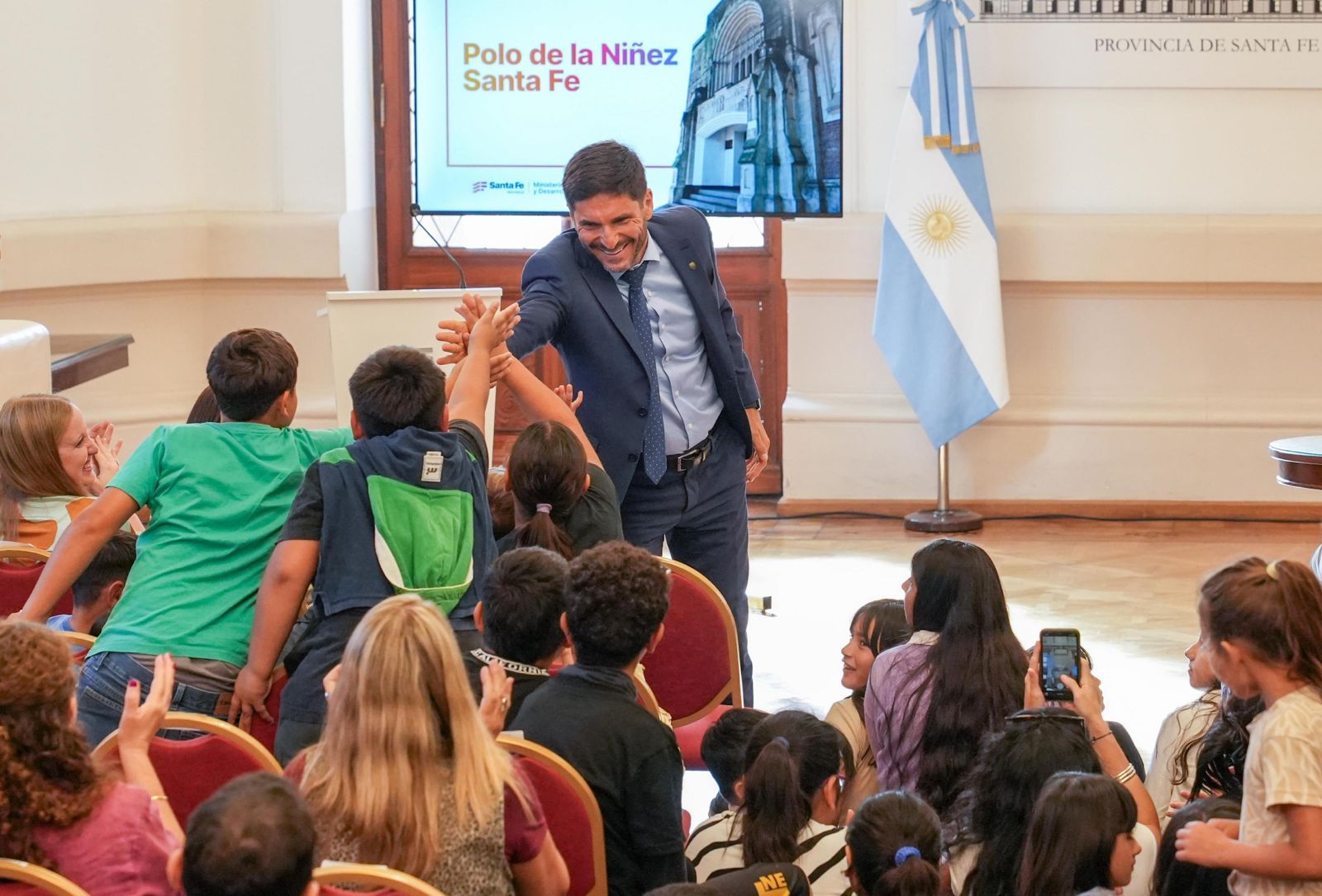
On Wednesday, the Governor of Santa Fe, Maximiliano Pullaro, presided over the signing of the deed of sale for the building that houses Casa Cuna, currently owned by the Society of St Vincent de Paul. The building, located at 2388 San Juan Street in the city of Santa Fe and founded in 1935, will be used to create the Polo de la Niñez, a comprehensive centre aimed at strengthening policies to protect children and adolescents whose rights have been violated.
The initiative forms part of a provincial strategy seeking to improve the institutional response to situations of social vulnerability. This is the second facility of its kind in the country: the first is due to be inaugurated shortly in the city of Rosario.
A government that prioritises children
During the ceremony, Pullaro stated that the Children’s Centre demonstrates that “things can be done differently” and highlighted the importance of promoting public policies that transcend individual administrations and endure over time. “We want to be remembered for the changes that enable them to reclaim their rights,” he said. He also explained that the provincial government has launched a programme to improve conditions in all residential care homes across the province and provide them with the necessary resources to operate.
The governor was accompanied by the former deputy governor and current Member of Parliament, Gisela Scaglia; the Minister for Equality and Human Development, Victoria Tejeda, and the Minister for Health, Silvia Ciancio; the Secretary for Children, Young People and Families, Daniela León; the Director General of Legal Affairs at the St Vincent de Paul Society, Agustín Obligado; the organisation’s representative, Juan Carlos Batistela; the provincial Ombudsman for Children and Adolescents, Juan Cruz Giménez; and the head of the Mundo Pequeño Foundation, Raúl Dalinger.
Unprecedented resources
The Secretary for Children, Adolescents and Families, Daniela León, highlighted that the initiative will enable the city to reclaim a building of heritage value and repurpose it through the Children’s Hub.
As she explained, the centre will operate every day of the year and will become a permanent space for listening to and supporting children and adolescents. “It will be the cornerstone of the system for the promotion and protection of rights, with a centre open permanently so that every child and adolescent has a place where they can be actively listened to,” she stated.
Raúl Dalinger, director of the Mundo Pequeño Foundation, highlighted the scale of resources the provincial government is allocating to children’s policies. “In 20 years of working in the region, we have never seen so many human and financial resources dedicated to restoring children’s rights in the province,” he said. Mundo Pequeño runs residential centres that work in partnership with the provincial Children’s Services department. Dalinger highlighted that the creation of the Children’s Centres could become a benchmark at national level. “This will serve as a model and inspiration across the country. It means putting an end to improvisation, because for many years, when there was a situation of rights violations, we were faced with a system that was unprepared,” he stated.
How the Children’s Centre will operate
The new facility will have staff on duty 24 hours a day, 365 days a year, and will be organised under the concept of “The Route of Rights”, a comprehensive care pathway in which the child or young person is at the centre of the intervention process.
This model aims to streamline procedures, avoid unnecessary transfers and provide rapid responses to critical situations, by bringing together in a single location the various government departments involved in the restoration and protection of rights.
In this way, for the first time in the province, it will be possible to comprehensively address the guarantee of the rights established in the Convention on the Rights of the Child, through a mechanism that brings together specialist teams, round-the-clock support and coordinated action between different public bodies.
In parallel, the Provincial Government will also proceed with the acquisition of a property in the southern part of Rosario, where the Adolescent Criminal Responsibility Reference Centre will operate, another initiative aimed at strengthening public policies relating to children and adolescents.